

الروبوتات الدفاعية Defence & Tactical Robotics
NAVIGATOR COMPETITION RULES
- INTRODUCTION & OBJECTIVE
Scenario: The land is too dangerous for humans to reach the victims. Your team has been given a difficult task. The robot must be able to carry out a rescue mission in a fully autonomous mode with no human assistance.
Objective: The robot must search through a maze for victims, navigate treacherous terrain (hills, uneven land, rubble), dispense rescue kits, and signal the position of the victims. Time and technical skills are essential.
- TEAM REQUIREMENTS
- Team Size: Minimum 2 members, Maximum 4 members.
- Age: Junior Student Members must be between 14 and 19 years old as of July 1st of the competition year.
- Mentors: Each team must have at least one Junior Mentor (19 years or older).
- Roles: Every team member must have a defined technical role and should be able to explain their work.
- Supervision: Mentors must supervise students but are not allowed in the student work area during competition.
- ROBOT REQUIREMENTS
- Autonomy: Robots must be controlled autonomously. Remote control or manual control is not allowed.
- Dimensions: Height must not exceed 25 cm. No specific length/width limit, but must fit within start tile constraints.
- Construction: Any robot kit or building blocks may be used. Drones or hovercrafts are prohibited.
- Safety:
- No sharp edges or pinch points.
- Lasers must be Class 1 or 2.
- Batteries must be stored in safety bags.
- Robot must have a handle for pickup.
- Controls: Must have a single physical binary switch/button for starting.
- Victim ID: Must be equipped with one specific LED or display dedicated only for identifying victims (clearly visible to referee).
- Restrictions:
- No pre-mapping (dead reckoning based on known field layout is prohibited).
- Robots must not damage the field.
- Robots may not have sensors that enable them to 'see' over walls.
- No intentional marking of the field.
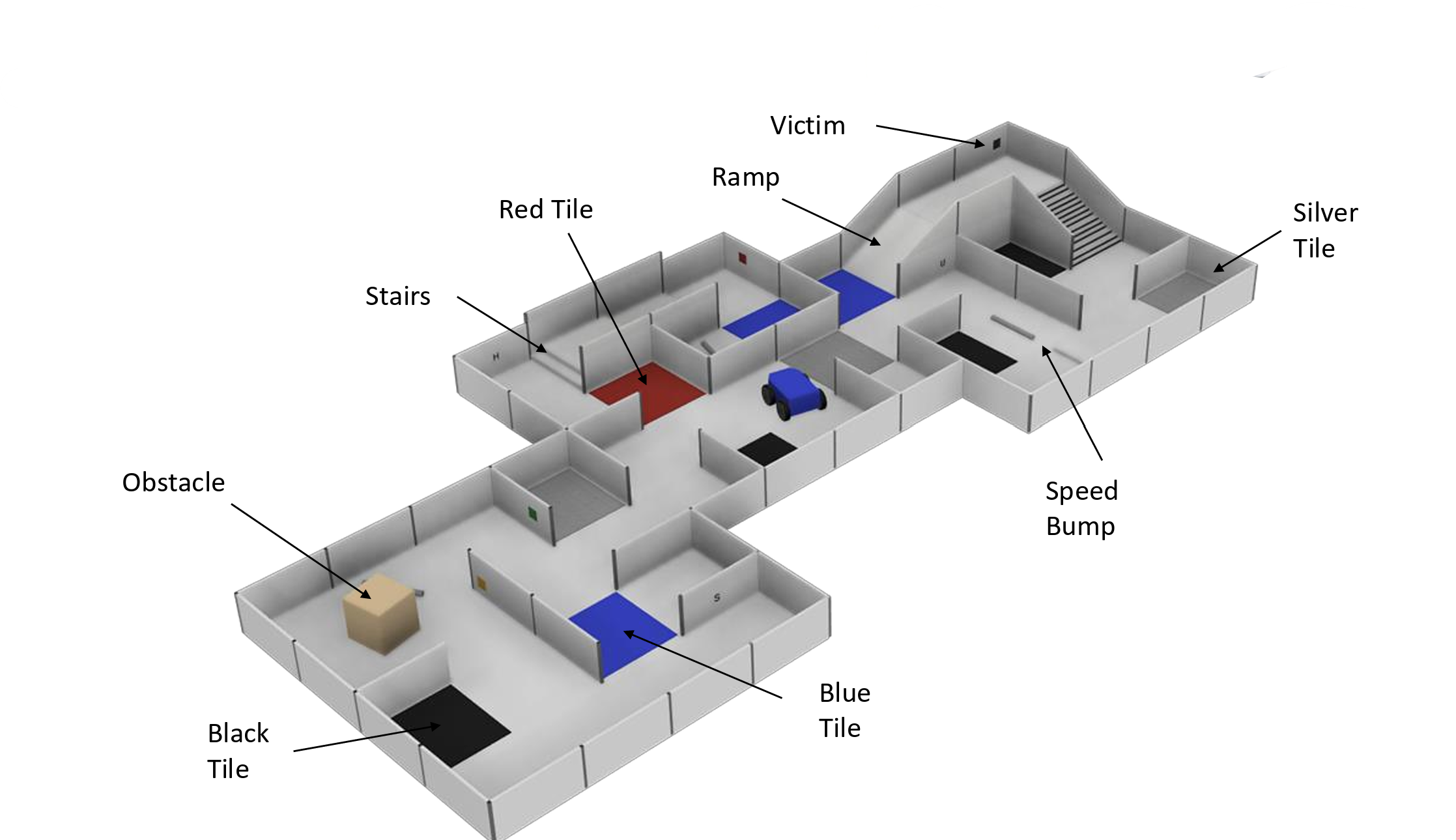
- FIELD SPECIFICATIONS
- Tiles: 30 cm x 30 cm unit squares.
- Walls: At least 15 cm high, 30 cm long, mounted on tile edges. Pathway width is 28 cm.
- Floor Colors:
- Black: Holes (must avoid).
- Silver: Checkpoints.
- Blue: Puddles/Hard terrain (must stop for 5 seconds).
- Red: Entrance to Dangerous Zone.
- White/Standard: Normal path.
- Terrain:
- Ramps: Max 25 degrees incline (30 degrees in Dangerous Zone).
- Stairs: Max 2 cm height per step.
- Speed Bumps: Max 1 cm height (2 cm in Dangerous Zone).
- Dangerous Zone: Marked by red tile, surrounded by walls, more challenging terrain.
- Start/Exit: One start tile (location varies). Robot must return to start tile for Exit Bonus.
- VICTIMS & RESCUE KITS
- Victim Types:
- Letter Victims: Uppercase letters on walls (Φ = Harmed, Ψ = Stable, Ω = Unharmed).
- Cognitive Targets: Concentric circles (5 rings) with color values (Black=-2, Red=-1, Yellow=0, Green=1, Blue=2). Health status = Sum of rings (Harmed=2, Stable=1, Unharmed=0).
- Location: Near floor (approx. 7 cm high), not on black/silver/blue/red tiles or obstacles.
- Rescue Kits:
- Robot can carry max 8 kits.
- Must be deployed within 15 cm of victim.
- Harmed: 2 kits required (30 pts).
- Stable: 1 kit required (10 pts).
- Unharmed: 0 kits required (0 pts).
- GAME RULES
- Time Limit: 8 minutes per game (includes calibration and scoring run).
- Calibration: Allowed before scoring run. Clock continues running.
- Start: Robot placed on start tile by referee.
- Lack of Progress (LoP):
- Occurs if: Captain declares, robot visits black tile, robot violates blue tile stop rule, robot damages field, or human touches robot/field without permission.
- Penalty: Robot returns to last checkpoint (or start). Score for that run resets; continues with remaining time.
- End of Game: When time expires, captain calls end, or robot returns to start tile (Exit Bonus).
- SCORING SYSTEM
7.1 Victim Identification (Successful Victim Identification - SVI)
- Linear Tiles: Letter = 5 pts, Cognitive = 10 pts.
- Floating Tiles: Letter = 15 pts, Cognitive = 30 pts.
- Requirement: Stop within 15 cm, blink LED (500ms ON/OFF) for 5 seconds.
7.2 Rescue Kit Deployment (Successful Rescue Kit Deployment - SRD)
- 1 Kit: 10 pts.
- 2 Kits (Same Victim): 30 pts total.
- Invalid: Delivering to unharmed victim or without prior ID (-5 pts misidentification penalty applies if ID attempted incorrectly).
7.3 Terrain Navigation
- Speed Bumps: 5 pts per tile passed.
- Ramps: 10 pts per successful up/down navigation.
- Stairs: 10 pts per successful up/down navigation.
- Checkpoints: 10 pts per visited silver tile.
- Blue Tiles (Successful Blue Tile Visit - SBV): 30 pts for first visit. -10 pts for each revisit (min 0).
7.4 Bonuses
- Reliability Bonus: (SVI × 10) + (SRD × 10) + (SBV × 10) - (LoP × 15).
- Exit Bonus: (SVI × 10) + (SBV × 10) + (Stair Nav × 5) + (Ramp Nav × 5). Requires return to start tile and blinking LED (1s ON/OFF) for 10 seconds.
7.5 Penalties
- Misidentification: -5 pts (if LED blinks outside 15 cm radius of victim).
- Total Score: Cannot go below zero.
- COMPETITION STRUCTURE
- Rounds: Multiple rounds. Worst round(s) omitted from final score.
- Normalization: Scores normalized per round (Best Team = 100%).
- Final Score: 60% Field Score + 20% Rubrics (TDP/Video/Poster) + 20% Technical Challenge.
- Technical Challenge: Mini-tasks to modify robot behavior quickly (announced at competition).
- SuperTeam Challenge: Collaborative task between teams (optional/independent).
- CODE OF CONDUCT
- Fair Play: No deliberate damage to field or robots.
- Sharing: Teams encouraged to share technical developments after tournament.
- Violations: Warnings, session removal, or disqualification for repeated offenses.
- Mentors: Must not build/program during competition. Students must explain their own work.